
Eating differently, but above all eating intelligently: this is the major challenge in nutrition today for professional cyclists. "We are seeing fewer and fewer cravings among riders,", notes Julien Louis, nutritionist for the DECATHLON AG2R LA MONDIALE TEAM. Why is this happening? He sheds light on the new nutritional approaches that are now available to optimize performance on the bike.
1 - Nutrition during exercise: a strategic approach
a - The central role of the nutrition cell
The DECATHLON AG2R LA MONDIALE TEAM has three nutritionists who support riders ranging from juniors to World Tour athletes. Their mission: personalized monitoring during priority races, training camps, and sometimes even during individual training sessions. "Some riders to us spontaneously for advice. They are the main drivers of their own performance,"emphasizes Julien Louis.

b - Organization of race nutrition
Before each event, team managers are given precise nutritional recommendations: location of refreshment points, types of gels or bars to be used, presence of a musette bag, etc. These choices vary according to many factors: race profile, mileage, weather, technicality. These choices vary according to a number of factors: race profile, mileage, weather, technicality.
On the most demanding events, a chef accompanies the nutritionist to guarantee the nutritional and sanitary quality of the meals, particularly abroad. The menu is tailored to each rider the intensity of the race. "We weigh what's on each plate, and the recommendations are precise to the gram. The goal is not to restrict, but to optimize performance," explains Julien.
In racing, the unexpected is always the order of the day: weather conditions, team strategy, edges, breakaways... All these elements can upset the initial nutritional plan. You need to know how to adapt in real time.

c - Numerical benchmarks for racing nutrition
Today, riders very riders their carbohydrate needs. Plans are offered to them based on their role in the race. "A rider a breakaway will not have the same needs as a teammate protected in the peloton,", explains Julien.
- 60 g/h for the first few hours,
- then 90 to 120 g/h depending on the effort required.
riders these instructions on their handlebars as a reminder, but they must also know how to adjust their intake according to the vagaries of the race.
d - Two types of races, two nutritional approaches
- High-energy races (mountain stages, Ardennes and Flandria classics): the aim is to reach 100 to 120g of carbohydrates per hour.
- Less intense races (flat stages, shorter races): requirements are lower, but intakes are still adjusted to maintain a stable body composition.
2 - A decade of progress: the nutritional revolution
Ten years ago, it was thought that the body could assimilate no more than 60 g of carbohydrates per hour. Today, we know that we can go up to 120 g/h, by combining different types of sugar (glucose, fructose, maltodextrin...). "These discoveries have made it possible to avoid cravings and increase energy intake for the muscles", explains Julien.explains Julien. Nutrition is now just as strategic as training: watts and seconds gained also come from the plate.
No more cupcakes and wraps! Today, musette bags are filled exclusively with suitable energy products. Even if some riders still riders a little sweet treat, efficiency comes first: races last an average of 4 to 5 hours, and every calorie counts.
A few years ago, it was still necessary to convince people. Now, riders asking for it. Their experience has taught them that pleasure products are no substitute for the effectiveness of foods specifically designed for exercise.
3 - Post-exercise nutrition: recovering for a better start
a - A strict recovery protocol
The two to three hours following the race are crucial for recovery. The protocol is precise:
- 1st hour: sweet, protein-rich snack, soda and 30g of sweets to reach 70g of carbohydrates.
- 2nd hour: solid meal, often savory (pasta salad, flan, etc.), aiming for between 70 and 120g of carbohydrates depending on the riders weight.
Next, the riders for a massage, then have their evening meal.

b - An individualized post-race analysis
After each race, the power files are analyzed. The goal is to tailor calorie intake on a case-by-case basis. "If a rider been in a breakaway when it wasn't planned, meals will need to be adjusted to compensate for the effort,"explains Julien.
Each rider different needs, depending on their weight, role, and energy expenditure. The goal is to maintain a perfect balance between what is consumed and what is expended.
4 - What about hydration?
Here too, nothing is left to chance. riders drink between 500 ml and 1 liter of water per hour. This is the physiological limit set by the rate of gastric emptying. "Even in extreme heat, you can't drink more than that. Drinking more than 1 liter per hour could lead to stomach discomfort or pain,"explains Julien.
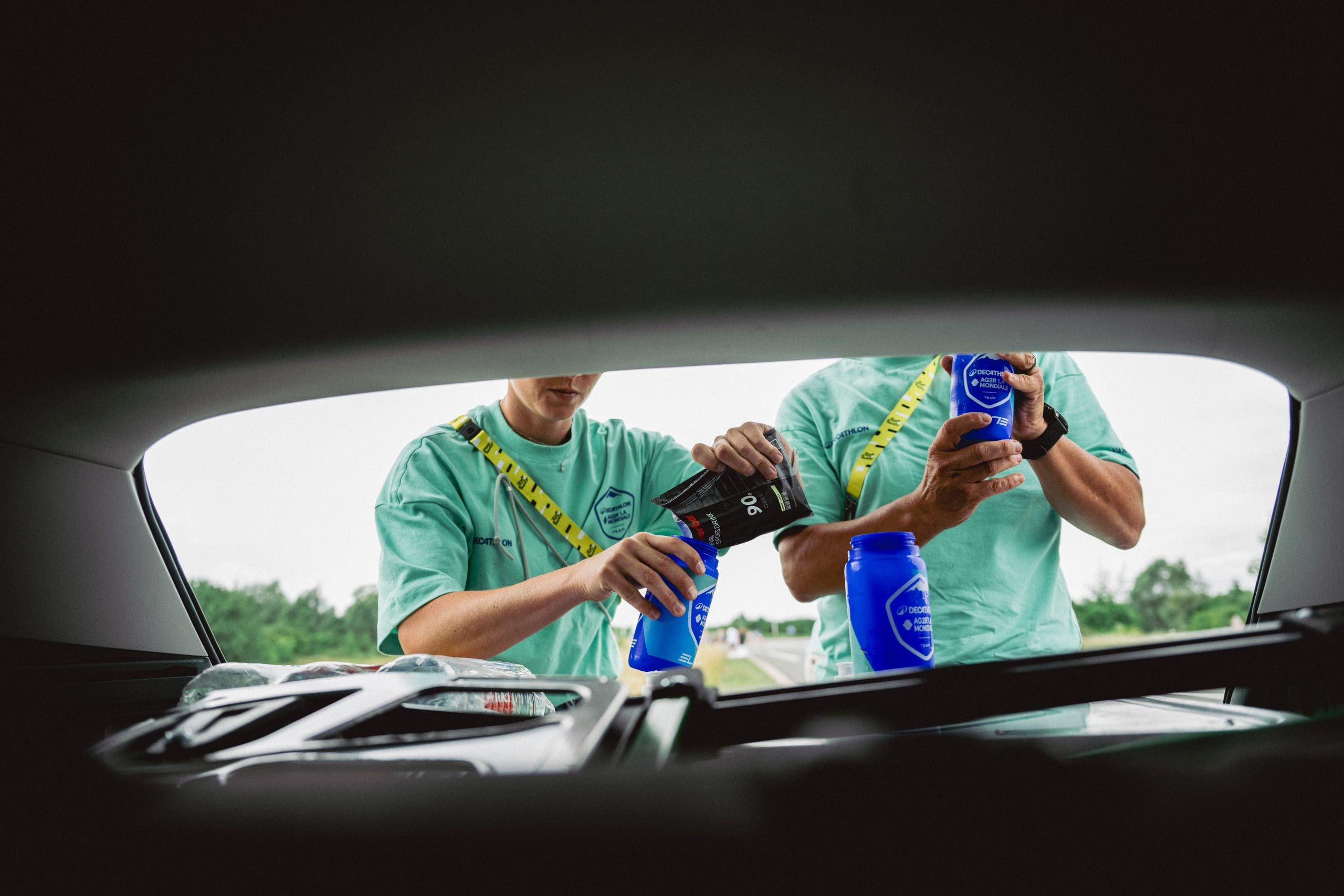
95% of hydration is provided by energy drinks. Pure water is only used as a supplement, particularly on summer races, to reduce taste saturation. Syrups have disappeared: they contain only one type of sugar, and are therefore less effective.
Nutrition isn't just for riders . For amateur cyclists, one energy drink per hour can already make a big difference. During intense training, adding one gel and one bar per hour provides 60 g of carbohydrates, which is an excellent starting point. In summary, for both riders and amateur riders , it's important to eat, drink, adapt... and above all, ride smart!