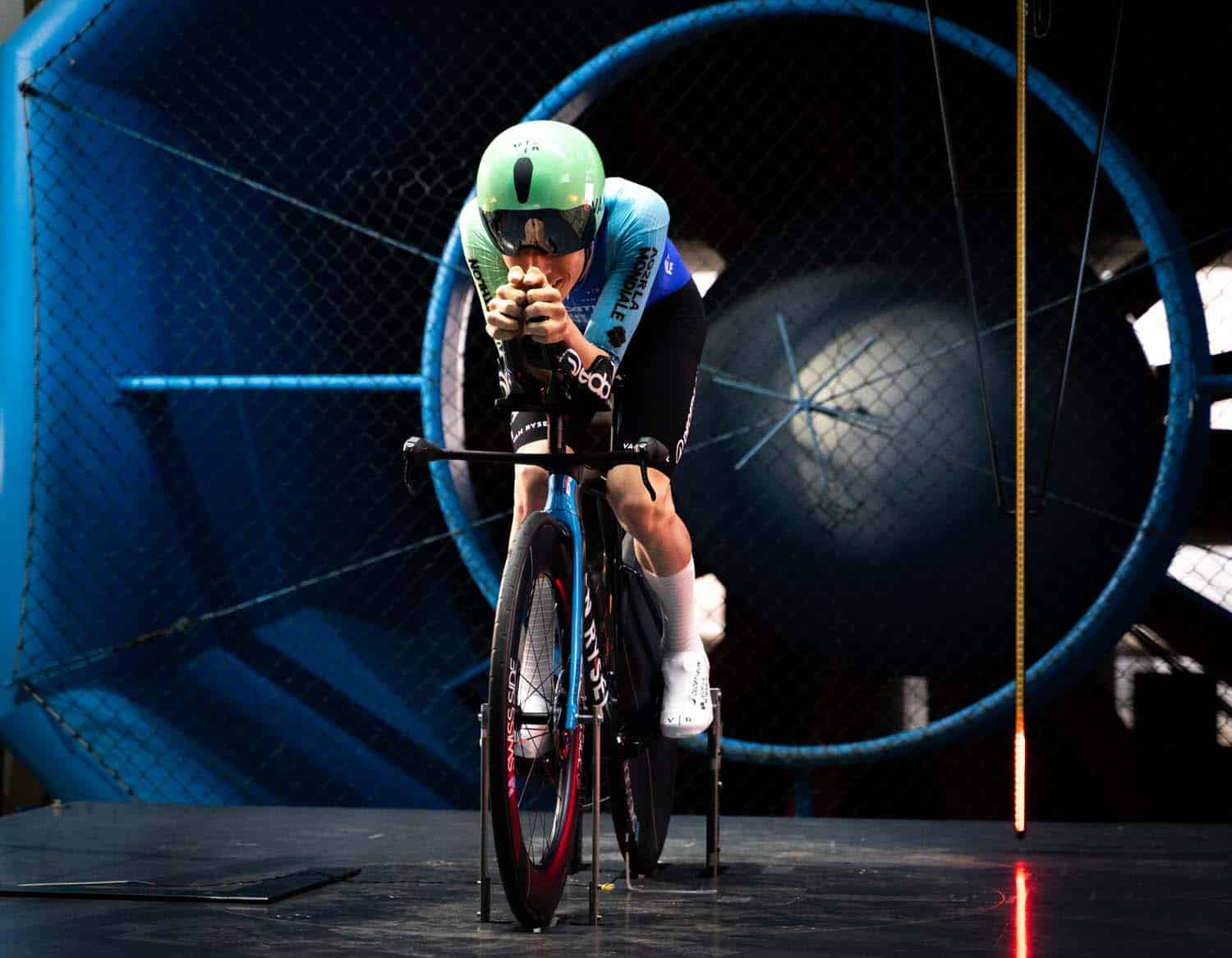

Immersion in a day of wind tunnel testing
In modern professional cycling, the quest for performance is no longer limited to physical training or nutrition. Every detail counts, and aerodynamics plays a decisive role. When a rider is travelling at over 50 km/h, approximately 90% of their power is used to combat air resistance. Gaining a few watts can translate into several seconds off a time trial... or a victory snatched at the finish line.
With this in mind, we travelled to Friedrichshafen, Germany, accompanied by our partner Swiss Side. A valuable partner with extensive experience in Formula 1, with whom we share the same high standards of precision and performance.
The choice of location was no coincidence: it is one of the most advanced and rigorous wind tunnels in Europe.
There, the aim is not only to validate existing choices, but to take the thinking further. Observe, compare, understand and, often, discover. The wind tunnel is both a validation tool and an exploration laboratory, where intuition rubs shoulders with physical reality.
1. How does a wind tunnel work?
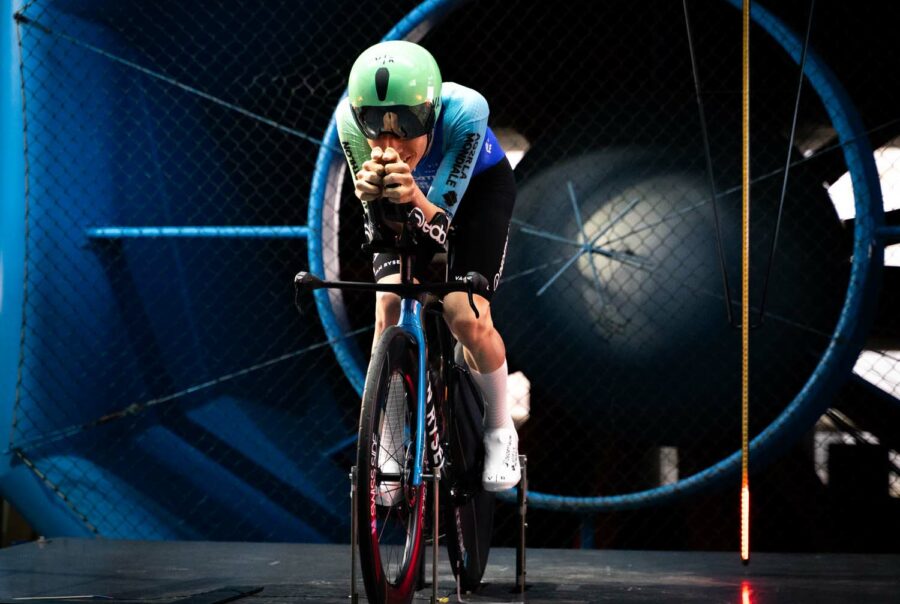
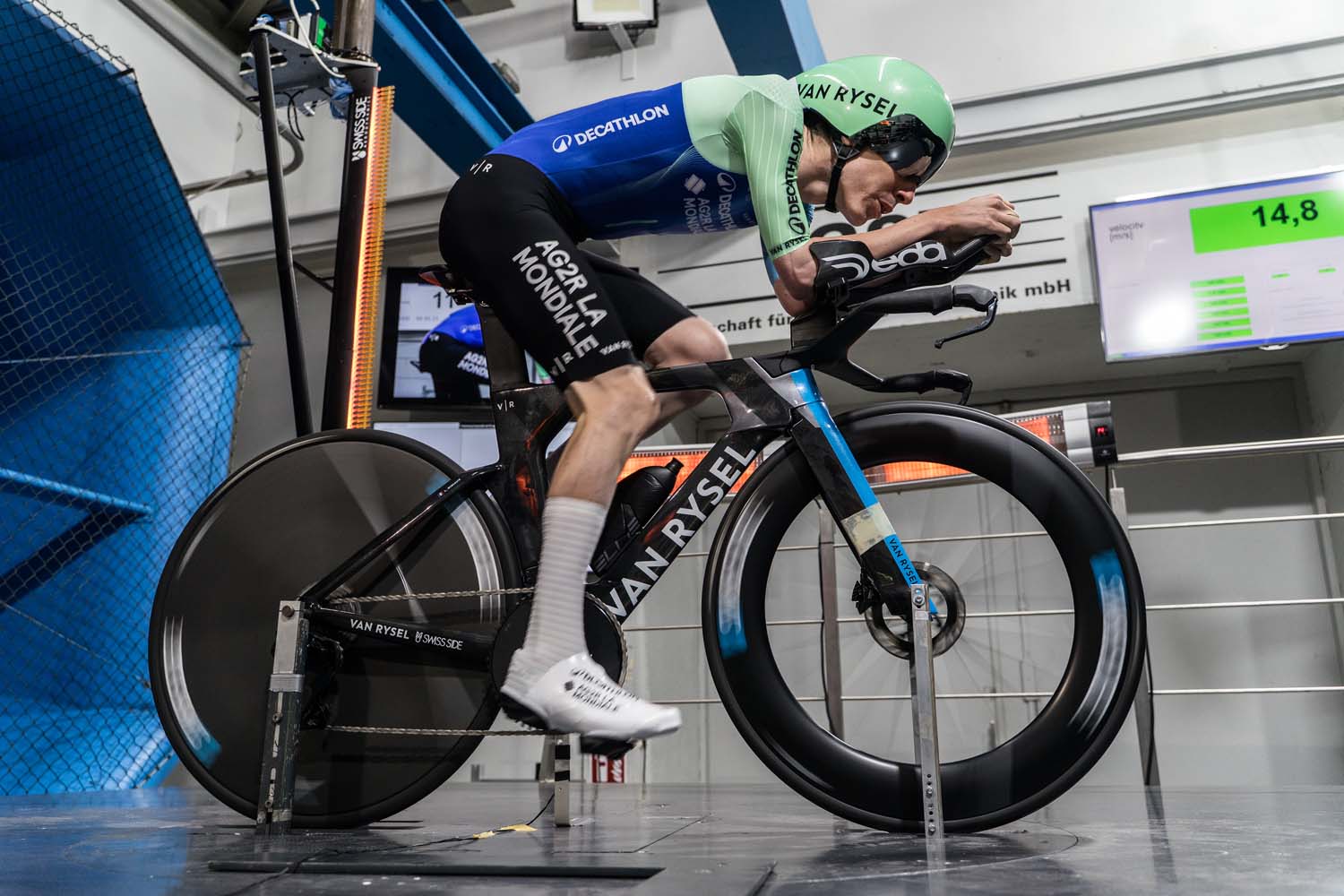
The term “wind tunnel” can be misleading, since in fact the opposite occurs: air is not blown towards the runner, but sucked in behind them. This principle generates a turbulence-free air flow. As a result, the data collected is extremely stable, and the variations measured are truly due to changes made to the runner or their equipment.
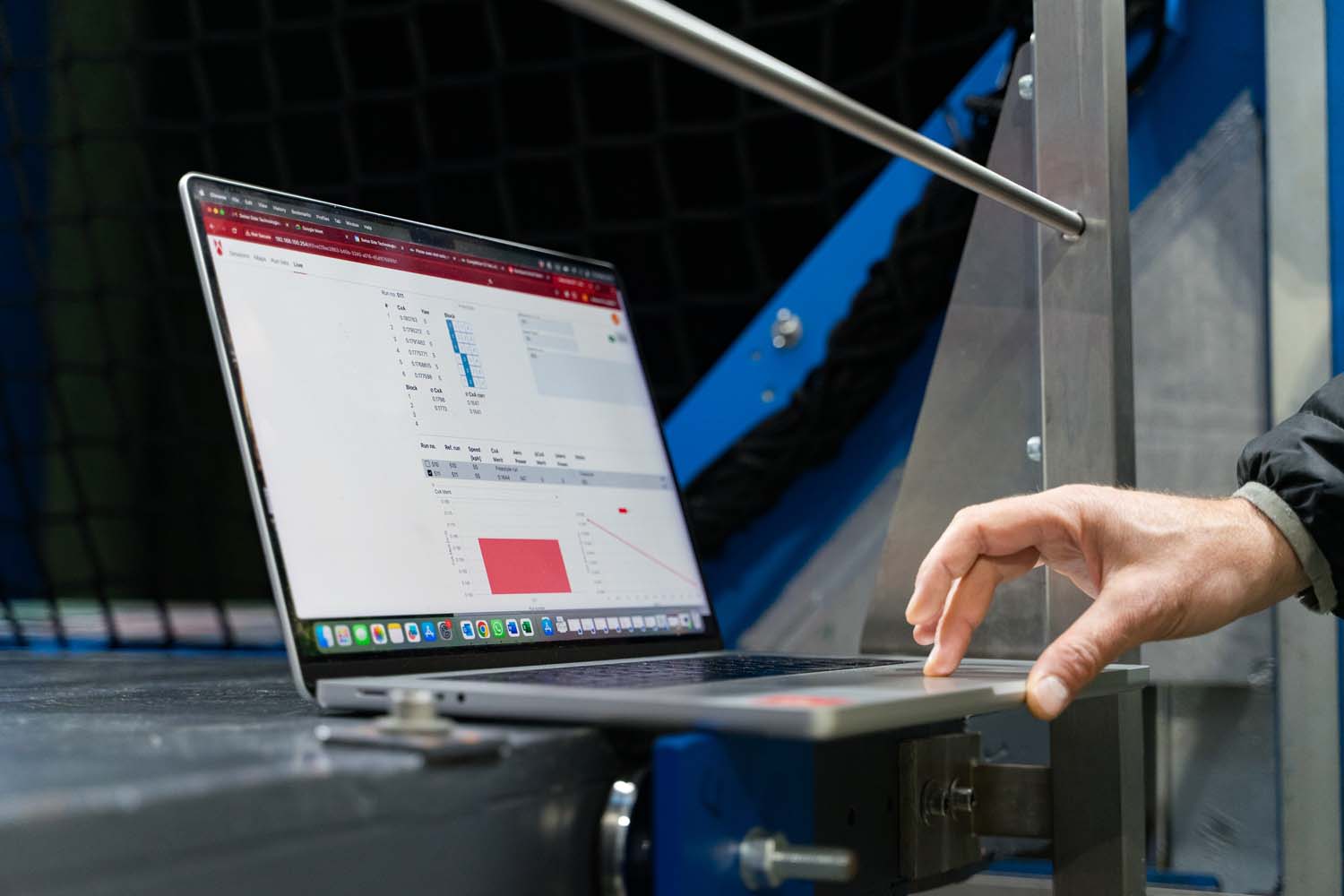
On the ground, a precision scale records the forces exerted on the rider, allowing their aerodynamic drag coefficient (CdA) to be calculated. This figure alone summarises a rider's ability to «cut through the air». The lower it is, the more efficient the rider is. From there, the CdA is converted into aerodynamic watts, i.e. the power that a cyclist must exert solely to overcome air resistance at a given speed, simulated here at 55 km/h.
Bjorn, an engineer at Swiss Side, adds: «Aerodynamic power is the power that needs to be developed just to overcome aerodynamic drag, but not rolling resistance, transmission friction or other losses. It's a pure, isolated figure that allows us to make comparisons.»
The tests are also carried out at different angles of incidence to simulate crosswinds, such as those riders face in real-world conditions. «If we only tested with a perfectly head-on wind, the data would only be valid in a velodrome,» adds Paul Barratt, our Director of Innovation.
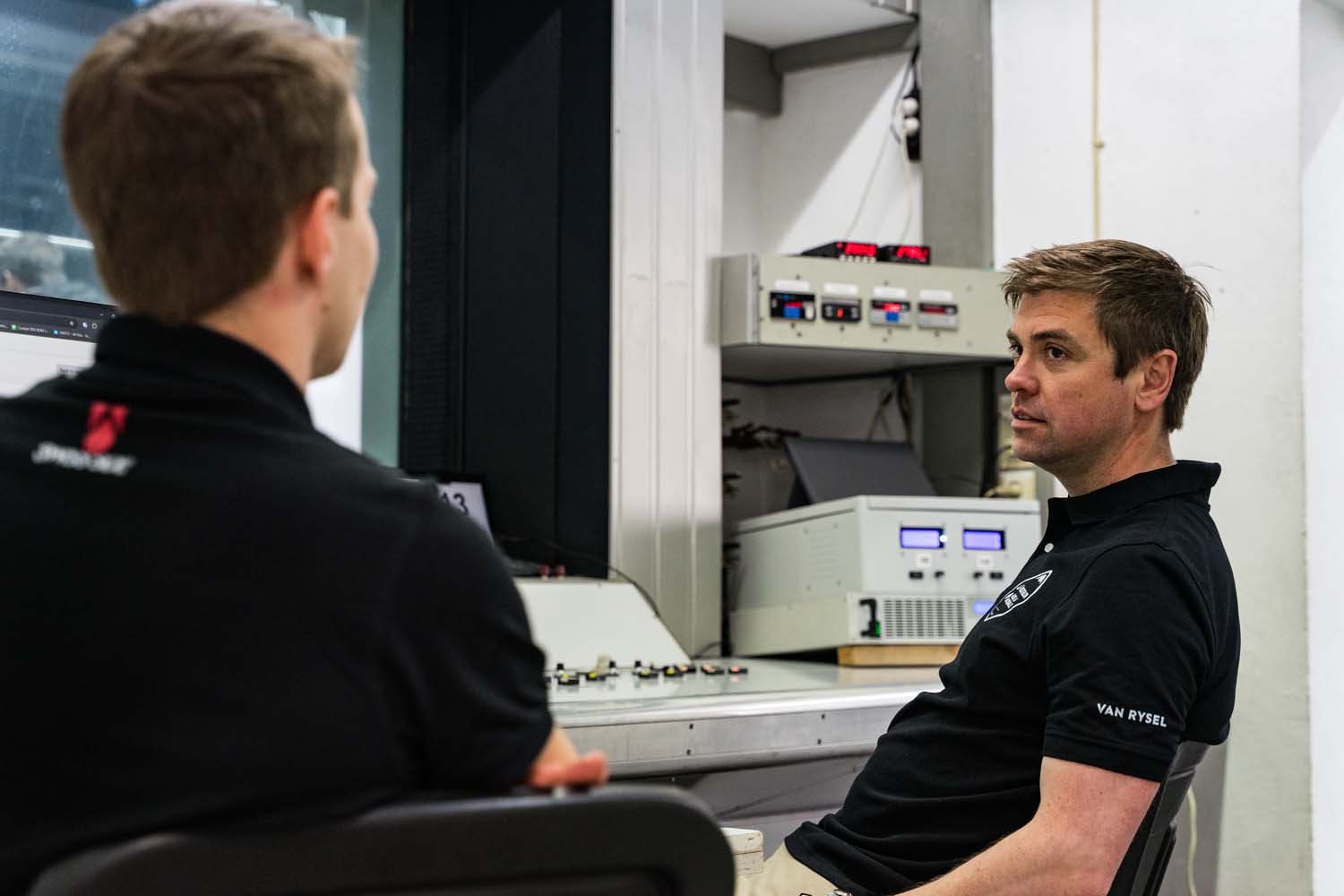
Finally, to complement the force measurements, Swiss Side uses a sophisticated tool: a system of dynamic pressure sensors that pass behind the rider during testing. The aim is to understand where turbulence occurs.
«The balance tells us if there is a difference, but not where it is. The pressure sensor creates a map of the air pressure drops directly behind the rider. This shows us precisely which areas of the body or equipment generate the most drag. And that's very valuable when working on helmets, textiles, or changes in the rider's position,» explains Jean-Paul Ballard, founder of Swiss Side.
2. The testing process
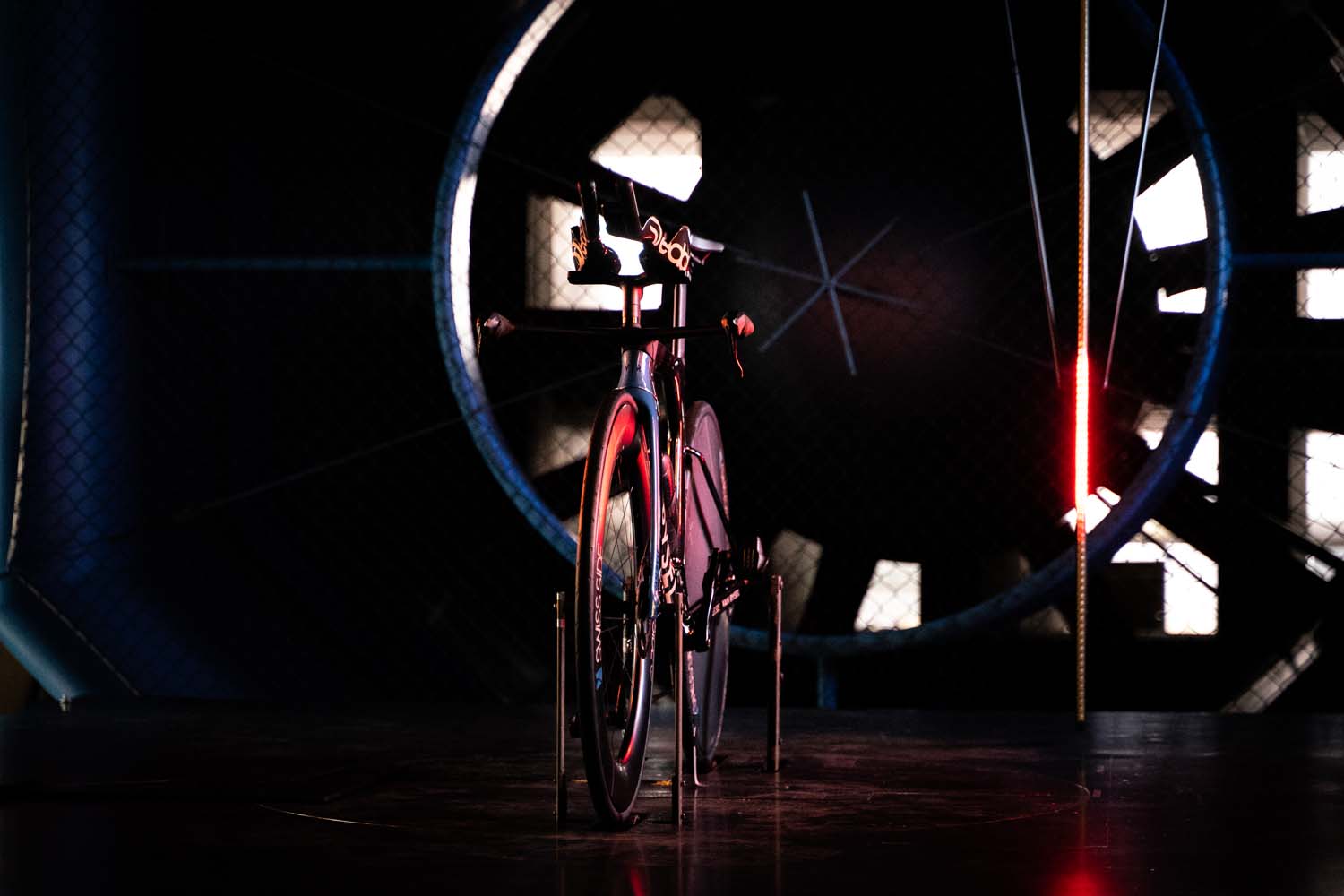
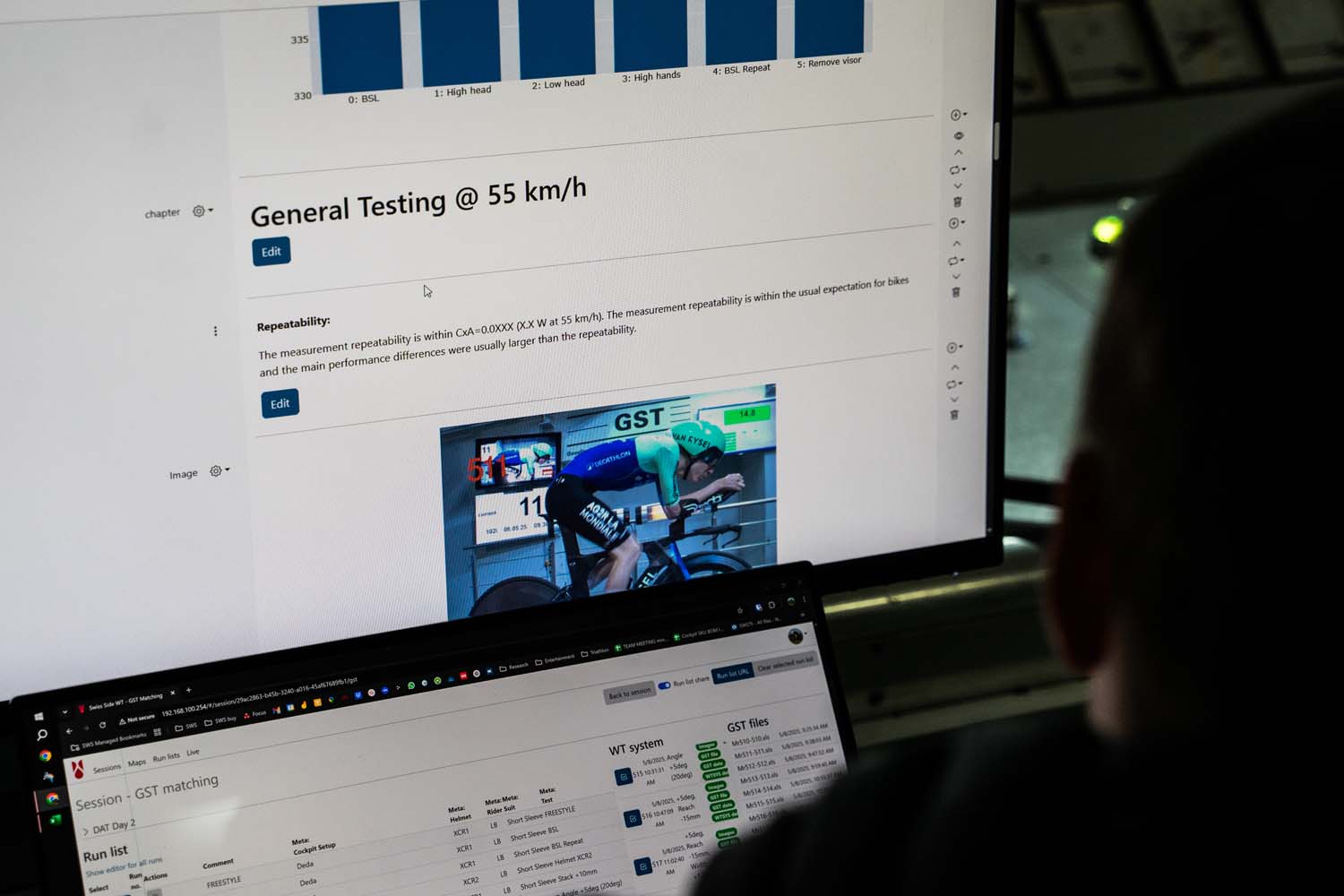
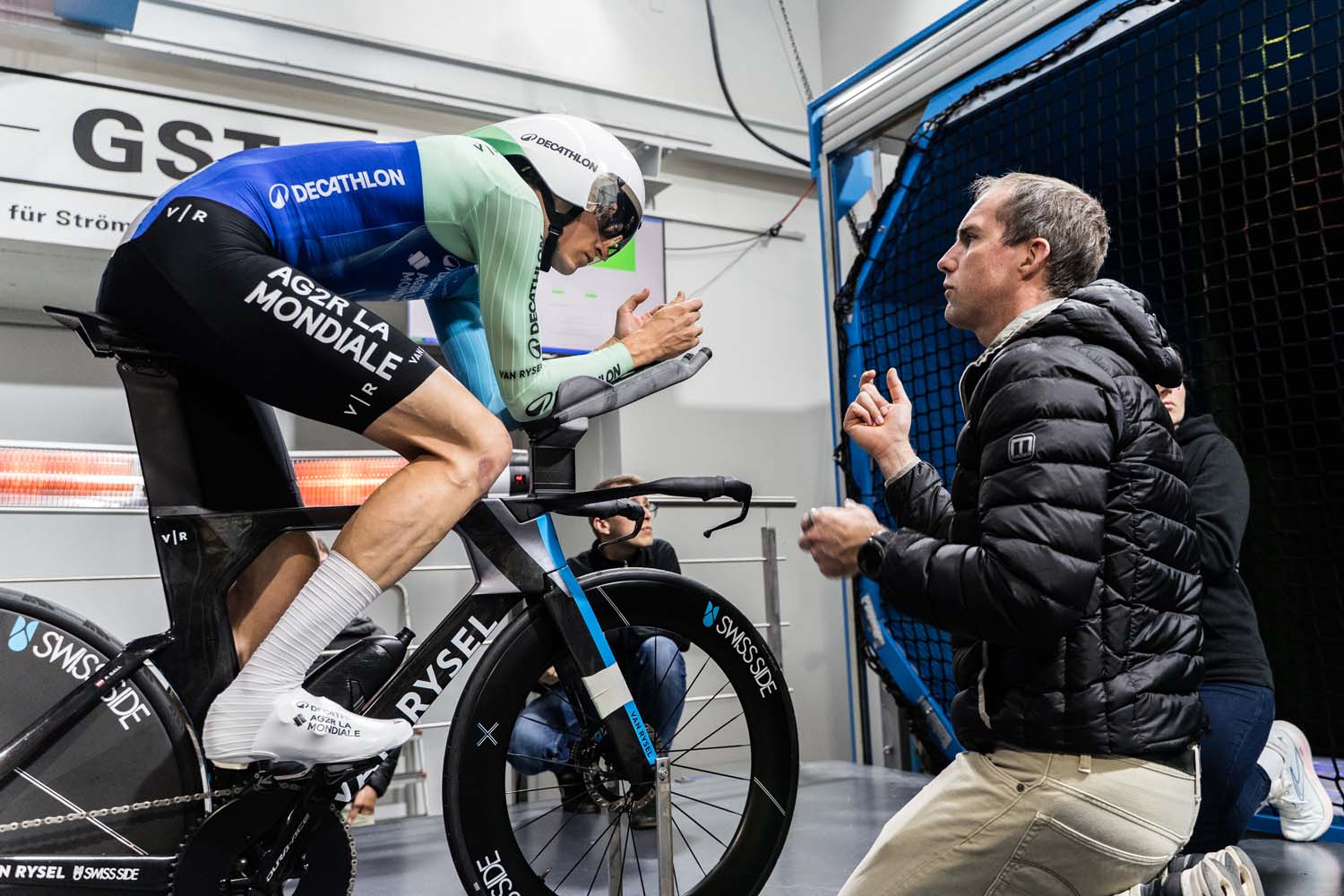
The day begins with Léo Bisiaux. This is his first session in the wind tunnel, and an opportunity to validate his position on the time trial bike. This had already been worked on by the performance team, and immediately proved effective, with a CdA measured at 0.179. We use this as a basis for making a series of targeted adjustments: increasing the angle of the aerobars by five degrees, bringing the arms 15 millimetres closer together, and refining the position of the head and torso. After these adjustments, the CdA dropped to 0.170. This corresponds to a gain of 4 watts, without compromising the rider's stability or comfort.
But the most memorable moment comes when he tries out the new Van Rysel time trial helmet, fresh from the design office. Léo is one of the first to test it. The result is striking: an additional 11.7 watts are saved. «I thought I would gain a little more with the adjustments, but my position was already good,» explains Léo. «On the other hand, the difference that the helmet makes... nearly 12 watts on its own, it's crazy.»
Mathias Ribeiro Da Cruz, the team's innovation engineer (and last year's French amateur time trial champion), points out that these results are highly personal: «What works for Léo won't necessarily work for another rider. The goal is to build a high-performance, sustainable position that is unique to each individual.»
3. Simulation and race strategy
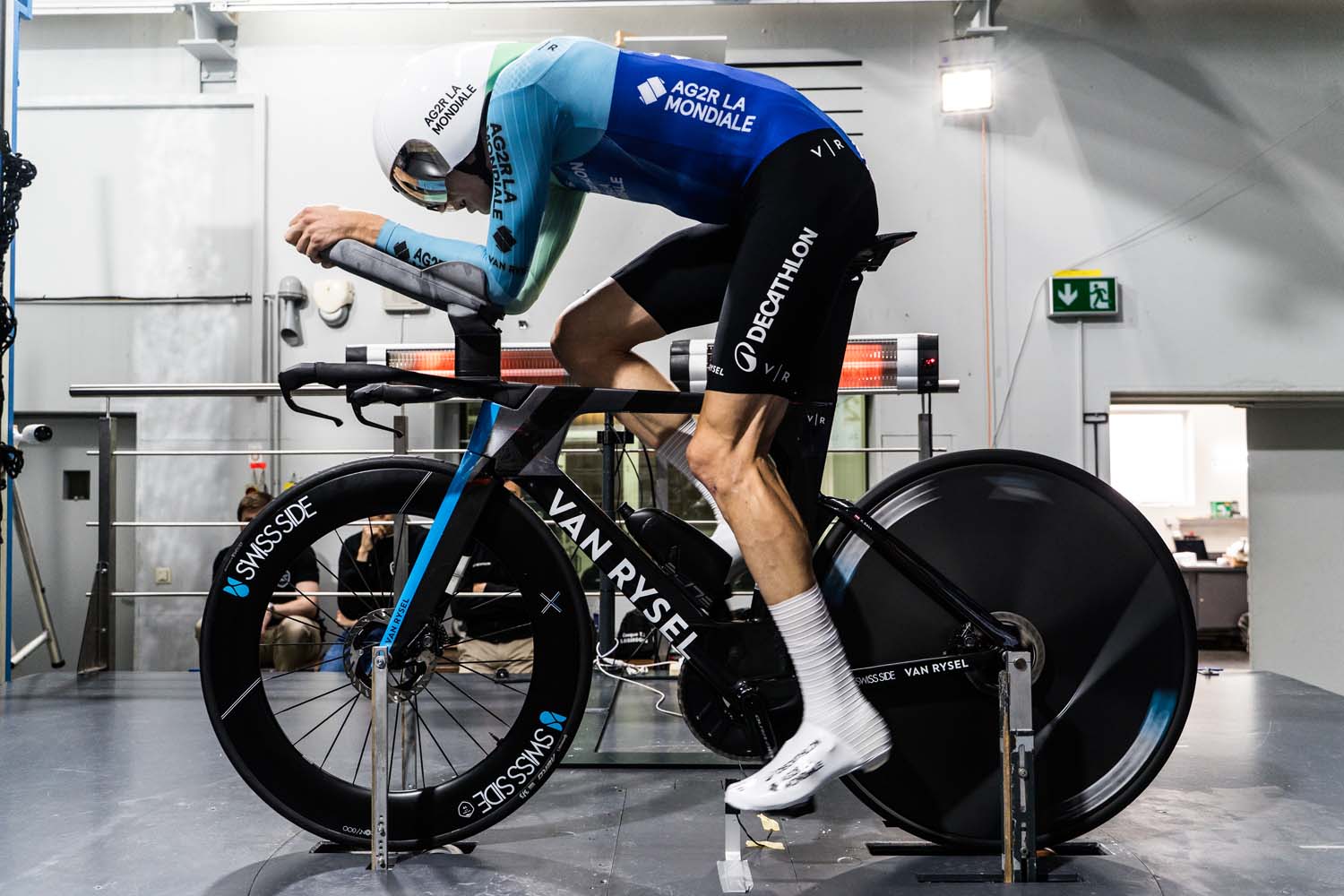
In the afternoon, it is the turn of Felix Gall, one of our leaders, to take to the stage. The challenge is strategic: optimising his equipment for the Tour de France time trial in Peyragudes. The unique feature of this time trial is 3 km of false flat followed by an 8 km climb. The dilemma is classic but complex: should he prioritise the aerodynamics of a time trial bike or the lightness of a road bike equipped with aerobars?
We test both configurations in a wind tunnel at different speeds, recording the CdA, positions and sensations. All this data is then integrated into simulation software developed by Swiss Side, which can accurately model the course of a race, taking into account the profile, weather, weight and equipment used. This software simulates hundreds of combinations and identifies the fastest setup for the rider's profile and the race. It is even possible to simulate the benefits of changing bikes mid-race, a bold strategy that can sometimes pay off.
Felix is also testing the new Van Rysel helmet, which offers a 10-watt gain. This helmet was developed using the body measurements of Bruno Armirail, two-time French time trial champion. Bruno did not use it when he won his last title, but it had already undergone extensive optimisation work. He won by three seconds. It's not much, but it was enough. And that's exactly what the wind tunnel does: it turns a performance hypothesis into a measurable reality.
4. A collective approach
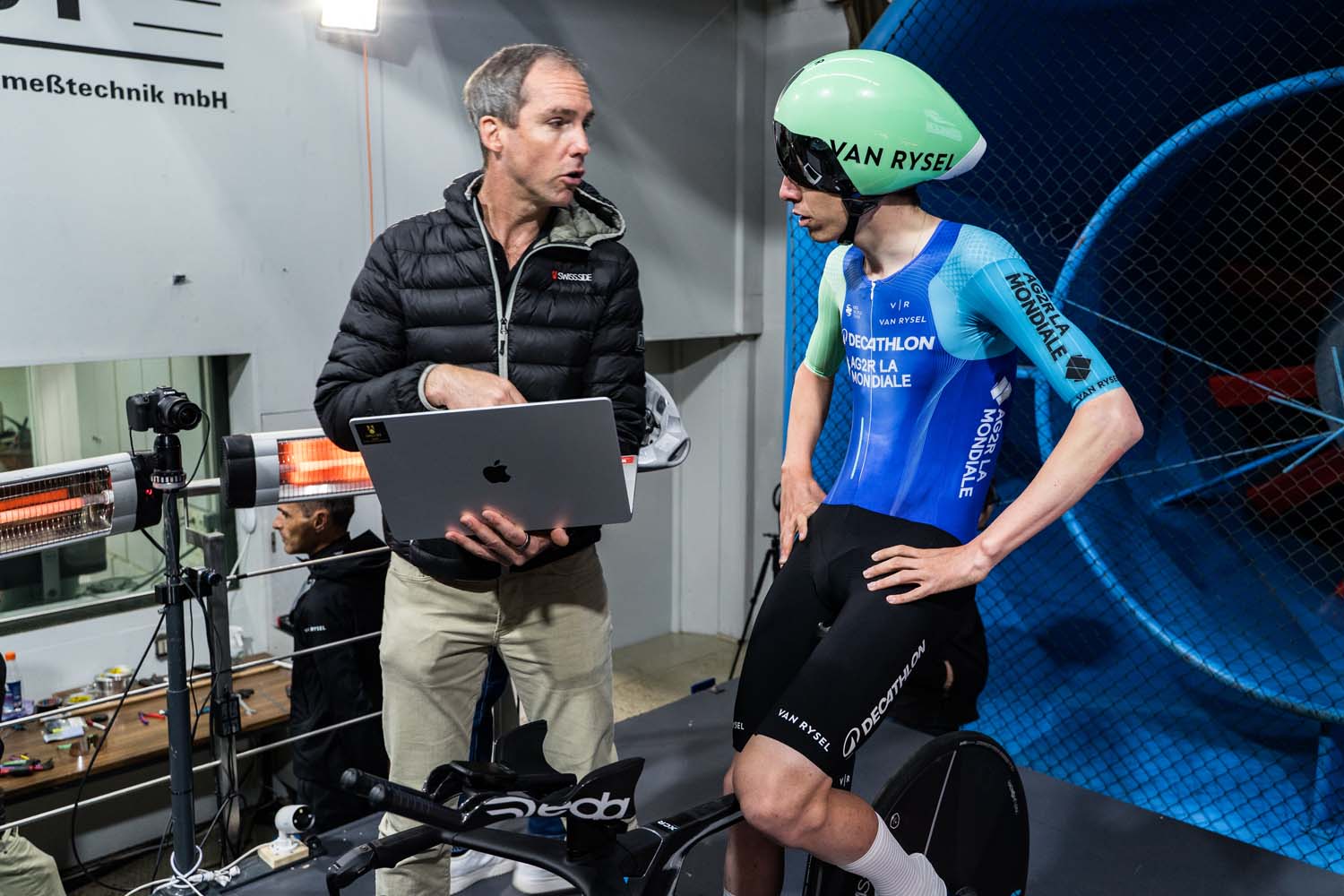
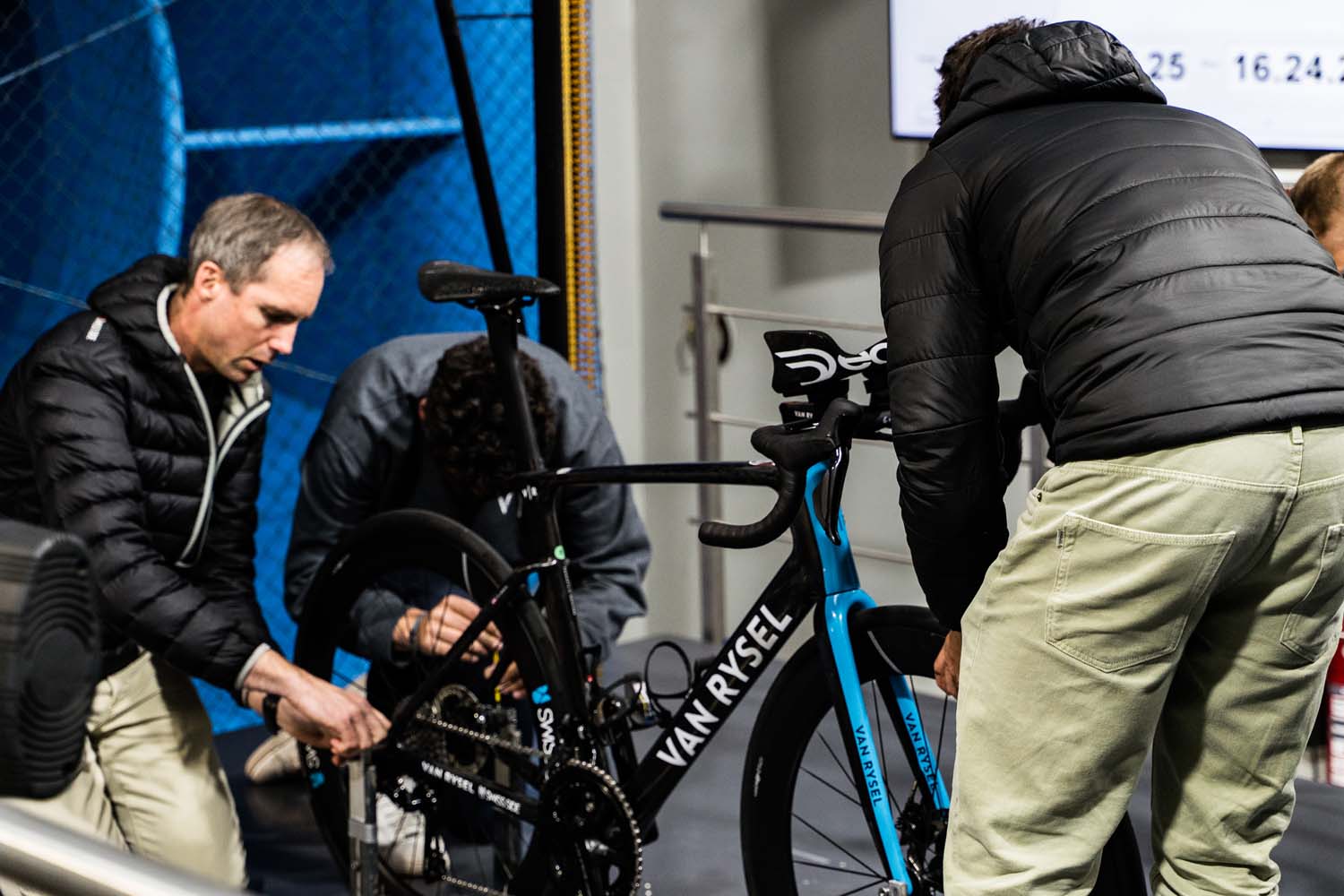
Behind every wind tunnel session, there is a real synergy between people and technology. Modern cycling is a team sport at every level. On the wind tunnel platform, surrounding the rider pedalling in a time trial position, there are dozens of eyes and tools observing, analysing, measuring and adjusting.
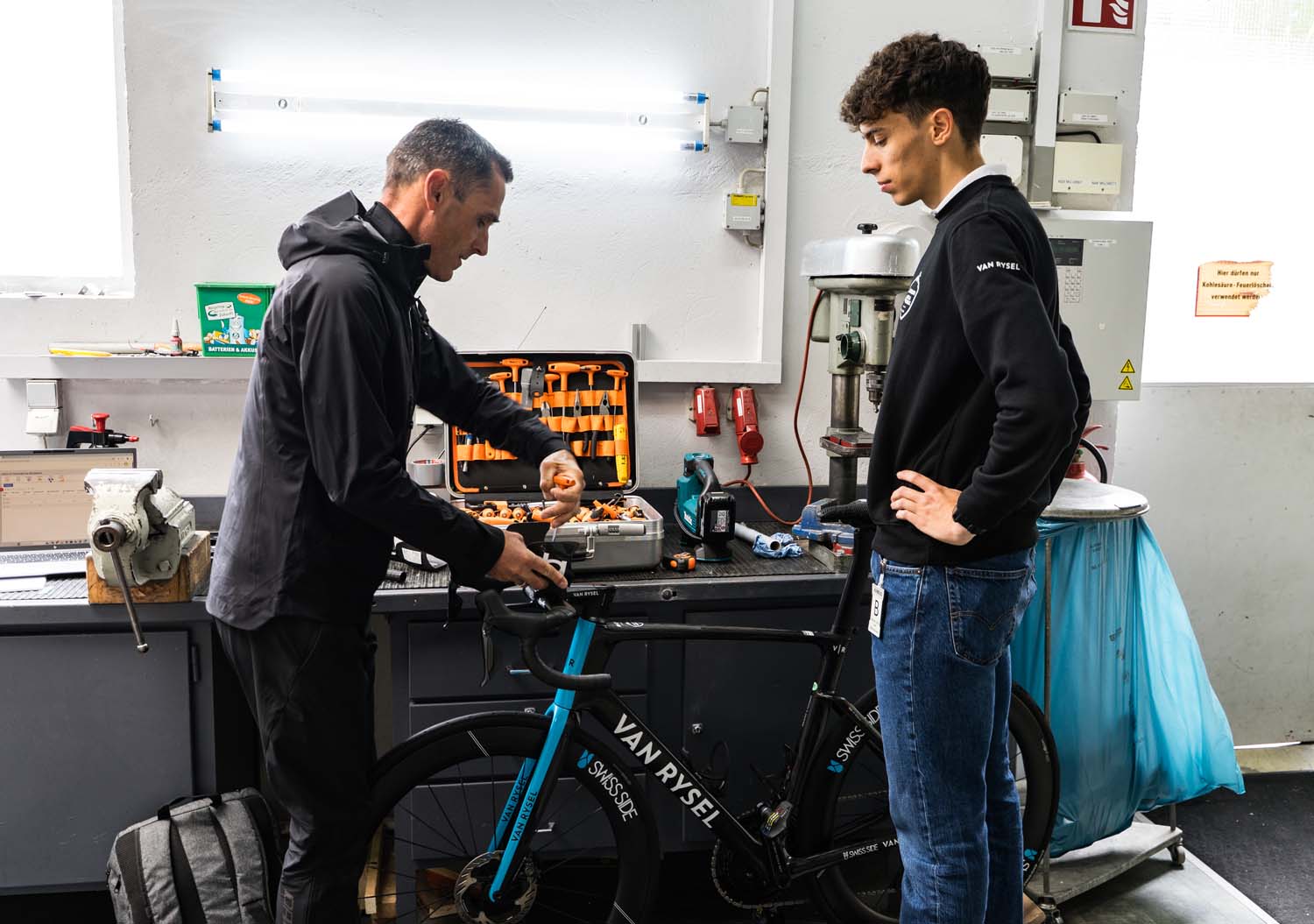
The fluidity between the roles is essential: Paul Barratt, Director of Innovation, discusses strategy with Swiss Side engineers and supervises the modifications made during the day; Mathias Ribeiro Da Cruz, Innovation Engineer, analyses the results in real time to adjust the protocols; Gilles Martinet, mechanic, makes precise modifications to the bikes; Alexandre Pacot, coach and positioning specialist, checks that the adjustments also respect the rider's physical abilities. All this is done under the watchful eye of Van Rysel engineers Louis and Alban, and our head coach Stephen Barrett, who is responsible for training and race performance and knows Felix and his abilities particularly well.
Paul accurately explains how marginal gains work: «Everyone talks about marginal gains as if they systematically add up to generate a massive advantage. In reality, we test a lot of things. Most of them contribute little or nothing. But sometimes, an idea has a huge impact. And that's exactly what we're looking for. The process is guided discovery. We start with a hypothesis, we experiment, we adjust. It's a testing ground.»
The wind tunnel is therefore not just a place for measurement: it is a space for dialogue, intuition and experimentation, where each member of the team contributes a complementary perspective to bring out the best possible solution.
5. Tangible results
The results of the day speak for themselves. Léo gained more than 15 watts between the position adjustments and the new helmet. Felix gained around 10 watts. These figures, translated into seconds in a time trial, could be enough to change the rankings.
But these gains are only valuable if they are understood and integrated by those who have to apply them: the riders themselves. That's why we always express these results in watts, a unit of measurement that speaks to them immediately. «Riders know exactly what it means to push 20 or 30 more watts. When you tell them that a helmet saves them 10 watts, it's not abstract: they realise the difference,» explains Paul Barratt.
Beyond the figures, the wind tunnel allows us to make technical decisions, confirm certain ideas and discard others. It is a decision-making tool. And for us, it is a key element in preparing for major events such as the Tour de France.
Each rider on the team undergoes aerodynamic testing at least once a year. The leaders return as soon as a key element (helmet, clothing, equipment, etc.) is ready to be tested. This is an essential step in our approach to performance.
The wind tunnel is not a technological showcase. It is a practical, demanding and sometimes thankless tool, but one that is extremely effective when used properly. It allows us to test, fail, learn and then succeed. It helps us turn ideas into measurable realities. Above all, it reminds us that in this sport, every watt counts, because every second counts.
But as valuable as these figures are, they cannot replace the essential: the runner's commitment, their ability to push themselves, to suffer, to fight for that fraction of a second when their legs are burning and everything seems frozen.
We do everything in our power to ensure that our athletes have the best possible conditions, the most accurate data and the fastest equipment. But ultimately, it is they who transform these efforts into performance. Because no simulation, no test, can model mental strength and the will to win.
And that is undoubtedly where the most beautiful part of cycling lies.