

“There was a kind of revolution in 2010 when cycling teams started looking at what was being done in athletics and swimming.”
Jean-Baptiste Quiclet, Performance Director at DECATHLON AG2R LA MONDIALE
This sentence caught our attention and piqued our curiosity when we spoke with Jean-Baptiste about the major contemporary developments in professional cycling. Our sport has always evolved rapidly. It's in its DNA. But never before in the last fifteen years have the changes been so numerous and radical.
Reduction in competition volume, sequencing of seasons by objectives, groups of runners, increase in training camps, etc. Behind the scenes of the performance unit, Jean-Baptiste explained to us how our riders' seasons are planned and organised. A complex task that requires coordinating a multitude of players (coaches, runners, sports directors, technical experts) and three major phases: preparation, competition, and rest.
For the ten or so coaches and experts who are the architects of this performance, planning has become a key focus.
1. Preamble: transformed seasons
If cycling seasons are among the longest in professional sport (approximately 10 months of competition spread out from January to October), the number of days spent competing by cyclists has been declining for two decades.
In the 2000s, a professional cyclist averaged 95 race numbers per season, while the most committed riders could accumulate up to 110 days of competition per year. In 2008, the winner of the Tour de France ended the season with more than 80 days of racing.
Twenty years later, Cyclists are running 20% less than before.. An average of 75 days, with a maximum of 92 days (Patrick Gamper in 2024). Contenders for the overall classification in the Grand Tours reduce the volume even further: Jonas Vingegaard did not race for more than 60 days in 2023, the year of his second Tour de France victory.
At the heart of this evolution is a change in approach to training and, more broadly, to performance: run less but better.
A new paradigm that has revolutionised seasonal planning and given pride of place to training, which has been intensified and optimised. At the heart of these changes is the increase in the number of training camps.

2. Train more and better
Today, A cyclist spends roughly as many days competing as they do training over the course of a season. (approximately sixty days for each of these two blocks).
In the past, cycling seasons consisted of a few months of endurance training in winter, followed by a very long season of competitions and (short) rest periods. Considering that competition was the best form of training, cyclists would race continuously until they reached peak fitness.
It was in 2010 that cycling took a new turn, drawing inspiration from other endurance sports such as swimming and athletics. In these disciplines, where the volume of competition is less than in cycling, seasons are structured around specific, long-term goals, making training phases distinct but essential to ensure competitiveness on the day.
That's what it is. desire to optimise performance and results who was the driving force behind these changes: better managing peak performance so as not to miss important events.
In addition, other more marginal factors have also prompted performance professionals to re-evaluate the importance of training in relation to competitions and to prioritise it in the organisation of seasons. According to Jean-Baptiste Quiclet, training allows athletes to:
- Reduce mental and physical fatigue generated by competitions (travel, stress, risk of illness).
- Better manage effort and workload Faced with the impossibility of predicting race scenarios, competition proved not to be the best place to control the intensity of effort. Technological progress has made training extremely precise and even «harder than races,» according to Jean-Baptiste Quiclet, our team's performance director.
- Remove constraints related to the implementation of certain preparation methods such as altitude training.
3. Performance structuring
This change in the way cycling is practised was a challenge for professional structures. With ultra-innovative teams leading the way, everyone quickly realised that they had to create the conditions for innovation.
In our team, The aim was to bring a fresh perspective to the preparation and to tailor it to the individual.. Jean-Baptiste Quiclet was a pioneer in this approach, which aimed to decouple seasonal planning from the simple global racing calendar.
In order to ambitiously rethink this planning and give itself the means to experiment, the performance unit of the DECATHLON AG2R LA MONDIALE team has been structured.
It is currently managed by its director, Jean-Baptiste Quiclet. He oversees performance in its various aspects:
- The’technical innovation : equipment, aerodynamics, nutrition, positioning. He is supported by multidisciplinary technical experts, innovators and implementation specialists.
- The training planning. Accompanied by Stephen Barret, Head Coach, who supervises a team of around ten coaches, all of whom are specialists.

A complete team motivated by a common goal: to enable the sporting management to’align the most competitive fronts in each race.
In their planning work, the team coaches develop various strategic plans at several levels:
- From shopping groups and sporting objectives for each group (Classic races, stage races, Grand Tours).
- From groups of runners in line with sporting objectives
- From preparation blocks for each group and structured around the main objectives
All this work leads coaches to produce the following for each runner in the squad:
- One race schedule
- One daily training plan
- One internship schedule
4. Types of internships and their objectives
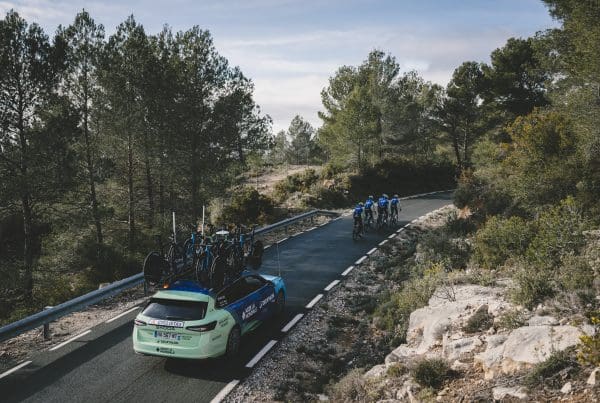
In this approach, training camps played a decisive role. Training camps were the subject of much discussion in the cycling world. Once questioned, it was considered that a cyclist could train seriously at home.
However, beyond the specific characteristics of certain training camps (such as those at the start of the season or at high altitude), professional organisations have increased their numbers with the same aim of optimising training, the backbone of all these transformations.
Although the technical objectives of the courses may vary, they are all designed to provide runners with an optimal working and recovery environment. They offer runners access to dedicated on-site staff to supervise training and provide the necessary support for care and equipment management (cook and nutritionist, physiotherapists, osteopath, mechanics, assistants).
Internships are also opportunities to bring together runners from the same running group and get them to work together, They are key to strong group cohesion and provide additional motivation to push each runner to exceed their limits during training.
Apart from the training camps at the start of the season, which are attended by the entire team, each training camp is attended by a maximum of ten riders in order to allow for a highly personalised approach to training during these key periods.
These courses are organised, prepared and placed by coaches according to their speciality: It is the sprinters' coach who organises the sprint training camps and the climbers' coach who leads the altitude training camps.
All training courses are organised around a specific theme. This theme generally constitutes an overall focus for a block of races, but it can also be linked to a specific race, such as reconnaissance training courses.
While the types of internships or their frequency may vary depending on objectives and staffing levels, there is a list of «core» internships that run throughout the seasons. Here are a few examples:

- The early season courses in December and January. These are carried out with the full team and serve to kick off the season. They are a valuable time for team building and groundwork on and off the bike, particularly thanks to numerous muscle strengthening sessions. They are also a time for discussions between the riders and all members of staff to plan each rider's season. Finally, it is a time to set up new equipment and any communication-related obligations.
- One The first altitude training camp takes place shortly after the first races., in February. They are mainly aimed at riders preparing for the Tour de France. The distinctive feature of altitude training camps is that they are particularly long. The acclimatisation period lasts several days and the benefits of altitude training only become apparent after several weeks. Riders who go on altitude training camps therefore find themselves in a real bubble of work for several weeks. They are in very small groups (including riders and staff), which also has the benefit of promoting group cohesion. In winter, these training camps mainly take place in Sierra Nevada in Spain, on the island of Tenerife or on Mount Etna in Italy.
- As the classics approach, reconnaissance courses may be organised.. They are used to carry out intense training sessions «in conditions» on the cobbles of the Flemish routes. They are also used to carry out essential equipment tests to ensure that these highly tactical events are approached in the best possible way.
- Depending on the objectives and the selected runners, a training camp in preparation for the Giro takes place in April. This year, it will be a training camp focused on sprinting, centred around Sam Bennett and the team that will accompany him on the Giro d'Italia.
- In In May or June, a second high-altitude training camp takes place in preparation for the Tour de France.. This is the final block of intensive training before the preparatory races for the Tour de France (Critérium du Dauphiné or Tour de Suisse). There are more destination options during the summer, as riders can go to high-altitude Alpine resorts (Les Arcs, Tignes, Val d'Isère) or Font-Romeu, which are located at sufficient altitudes to benefit from the advantages of altitude training.
- Depending on the schedule, mini reconnaissance courses take place at the beginning of summer to recognise the most important (or most technical) stages of the Tour de France.
- In July, riders who are not participating in the Tour de France undertake a «mountain training camp».» in order to work on significant elevation changes during training. This year, the training camp will be divided into two groups to promote individualisation: a Vuelta group and a group of riders committed to other objectives for the second half of the season.
- At various times during the season other «technical» courses may be organised to carry out in-depth work on the equipment or position: days spent in the wind tunnel.
So that's why and how. these training camps have become (among other things) a mainstay of the season of our runners and their quest for performance.
Seasons that are definitively structured around complex roadmaps, where the objective is now just as important as the route to achieving it.
While it is true that the place of the’training has evolved considerably, It has also made cycling even more competitive. Cyclists are racing less, but they are racing better.
Every race is a spectacle played by finely prepared and highly determined actors, particularly as their schedules become lighter. A call for panache, much to our delight.