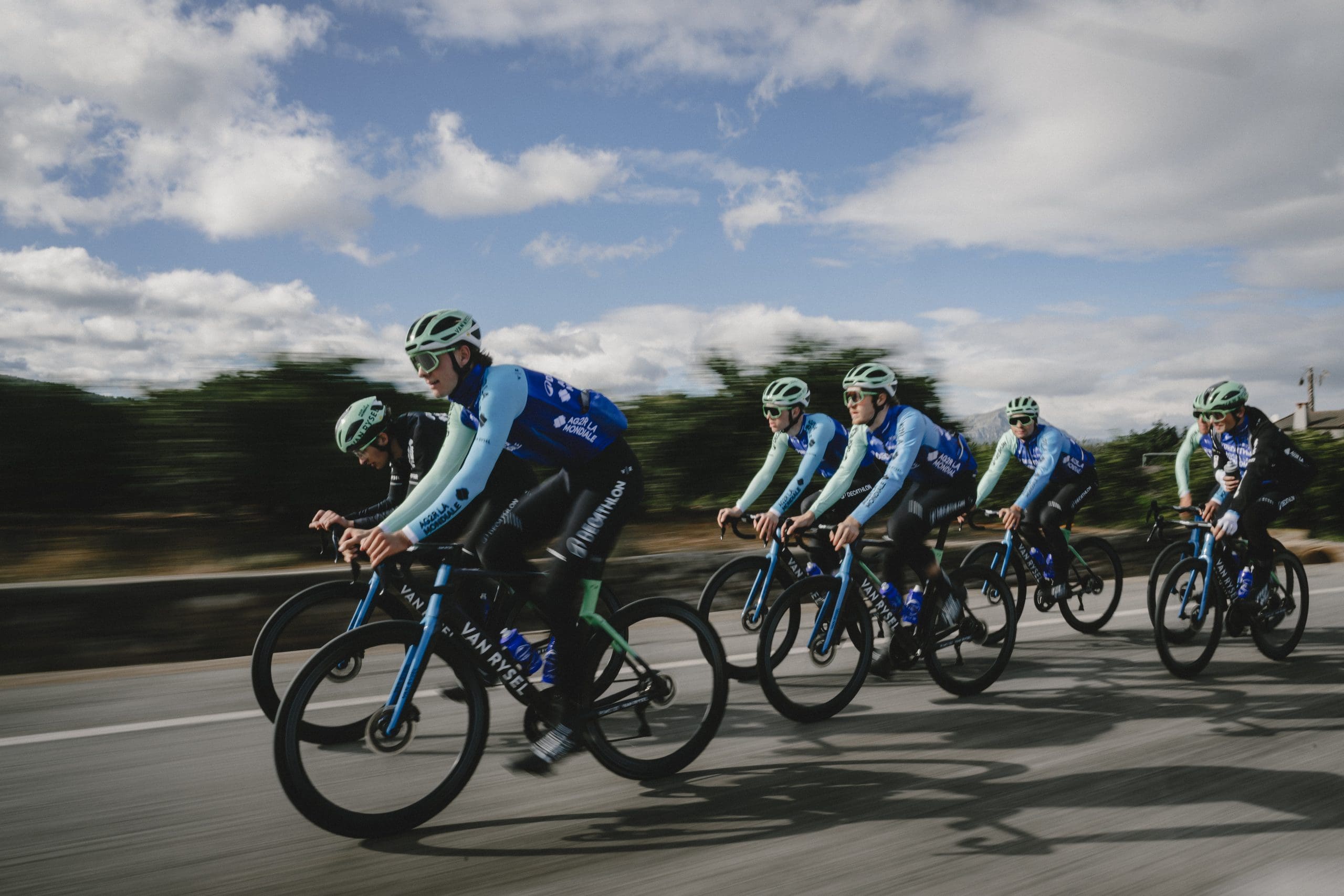

Data galore! But how can you make the best use of it?“Our primary role is to improve performance through science and technology., announcement Paul Barratt. In a sport where technology and data have taken over, it is sometimes difficult to extract anything concrete from all these figures, even though they can help riders gain a few watts and thus perform better and win races. Sometimes it comes down to a photo finish or thousandths of a second in a time trial: this gain in watts is essential, but you have to know where to find it. Meet our innovation and technical support team.
1 - New for the 2025 season
This is a new unit and a new department created this year within the DECATHLON AG2R LA MONDIALE team. It has always been a key focus for the team, but this year it has become more structured. A thoughtful and well-considered investment to improve performance. Behind the Innovation and Technical Support Division are two men working behind the scenes: Paul Barratt, Director of Innovation and Technical Support, and Mathias Ribeiro Da Cruz, Innovation and Technical Support Engineer.

2 - A permanent link with technical partners
The main role of this department is to act as a permanent link between technical partners and performance stakeholders, the sports management team and the riders.“We don't do anything ourselves, in the sense that we don't touch the equipment. However, we approach our partners with ideas because we know where the performance needs to be. And that's the key.” adds Paul. So you have to approach partners with ideas:
- which can be deduced directly from computers and analysed data
- which may come directly from the field following races and/or training courses
- which can be suggested by riders, depending on their needs, desires and how they feel on the bike
These ideas sometimes come directly from partners who also have a research and innovation unit dedicated to improving their products. The aim is to challenge ourselves and always try to improve what already exists: “Relations with our technical partners Van Rysel and SwissSide are really very good, we are aligned with our vision of performance and this allows us to aim far and high.” describes Mathias.
3 - Equipment designed from head to toe
The real novelty with the arrival of Van Rysel Since 2024, our riders have been equipped from head to toe by the same partner: from gloves to helmets to bicycles. “It’s a huge advantage, because when you’re looking to improve a product, you don’t think about it individually with your partner, but holistically. This is essential because each element interacts with the others.” explains Mathias. This facilitates discussions about products and interactions between all stakeholders.
4 - Runners as drivers of innovation
Runners therefore also have a role to play, even if “We don't wait for runners to come to us for ideas.” Paul explains. This was the case, for example, with Stefan Bissegger, a time trial specialist when he joined the team. “We met with him beforehand to offer him the best possible equipment, we had several discussions and carried out numerous tests..” A few discussions took place to work on customised extension cords adapted for Stefan.
Some riders like to look at the data and understand the choices made, while others are more inclined to let our engineers take the lead. Rider involvement is also very important when we have prototypes to offer them: their feedback is essential for moving in the right direction.
5 - Prototypes and testing sessions
Once the idea has emerged and our research and innovation department has processed it, we then have to try to implement it in practice with the help of our technical partners, and the prototype production phase is not the easiest. We have to manage, within a set timeframe, to produce a prototype that can be tested and adjusted for our riders, and which meets demand. “Producing a prototype is a lengthy and technical process, so you have to be vigilant.”, indicates Mathias. One might think that a prototype is simply a “test” object, but it is much more than that. Without prototypes, there would be no equipment suited to the needs of runners.
Once the prototype has been created, a testing session must then be organised at a velodrome and/or in wind tunnel. There are regular sessions, especially at the start of the season, but this can also happen during training camps or specific sessions. This was recently the case with the testing of a new Van Rysel helmet in the wind tunnel.

6 - Race analysis
The staff works hand in hand with our partner SwissSide, which has developed an all-in-one platform, allowing Paul and Mathias to analyse the race beforehand. “The platform allows us to simulate all races with elevation changes, mileage, weather conditions, etc. We enter the runner's power output, which allows us to choose the best equipment.” Everything is calculated down to the last millimetre for each day of the race:
- choosing a bicycle (RCR-F and RCR)
- the choice of wheels
- the choice of tyres
- choosing helmets
- and many other details that improve performance
All these equipment recommendations are then forwarded to the sports management team. Each choice can also be adapted according to the race strategy: if it is a stage race and a sprinter is going to spend several hours in the gruppetto, we will not offer him the same technical equipment and gear as a rider in the general classification, a mountain team-mate or a rider destined to break away.
7 - Collecting data for today and tomorrow
Once the finish line has been crossed, nothing is left to chance when it comes to the recovery of the riders and the technical elements: punctures, weather conditions and falls are recorded and stored on the IPOGEE platform, along with all the associated equipment, from head to toe. It is difficult to draw conclusions after just a few races, but over time, these collected elements will make it possible to deduce certain performance characteristics of the equipment, thanks to all these observations. The aim is to build up a stock of quantified information on all the races and training sessions carried out, in order to find commonalities and make use of all this data.
8 - Key player in race strategy, particularly in time trials
Thanks to the SwissSide platform and data analysis, Mathias and Paul are able to simulate the watts a rider will produce during a race, which allows them to adapt their race strategy, particularly in time trials. This makes it possible, for example, to simulate different race configurations: a fast start at the beginning of the time trial, climbing the hill at full speed, or, on the contrary, managing the hill to make a big comeback... small strategic details that can change the game. This information is then passed on to the sports management team, which, with all this data at its disposal, makes strategic decisions for the rider.
9 - A role to play in bike fitting for riders
It is a department that ultimately works with all of the team's services: mechanics, sports management, but also bike fitting with Alexandre Pacot, coach. “Our role is to ensure that the rider's position is optimised in terms of biomechanics and aerodynamics.” Paul explains. The position is not the same when you change bikes, but also when you change disciplines (road or time trial). When testing new equipment, it is therefore important to stay within the optimal physiological data for the rider's position.
10 - Innovation, a key issue for the future
And tomorrow? Once all these available figures have been analysed, what will happen? “Everything can always be improved and optimised; you just need to have the idea. It's a never-ending cycle.”, says Mathias. And to get ideas, we can look at what is being done in other sports, such as triathlon, where the issues surrounding outdoor endurance sports are similar. But above all, we can count on the tripartite functioning of this centre. For example, in the coming months and years, a study on the impact of fabrics on aerodynamics and performance in hot weather is planned. What is the optimal fabric for different temperatures? These are just some of the many questions surrounding this thermal theme that Van Rysel's experts are trying to answer. Check back soon to find out more about the study!

The main and common objective of this entire strategy is, of course, to optimise performance as much as possible, thanks to the data collected, but also thanks to new projects carried out hand in hand with our partners.